Listen to the Podcast:

Get The Article
Cite This Work

- APA
- MLA
- Bibtex
Reggente, N., & Schoeller, F. (2026). From selection to surgery: Aesthetic chills bridge subjective functionalism and cognitive calibration. Behavioral and Brain Sciences, 49, e307.
Reggente, Nicco, and Felix Schoeller. “From selection to surgery: Aesthetic chills bridge subjective functionalism and cognitive calibration.” Behavioral and Brain Sciences 49 (2026): e307.
@article{reggente2026selection,
  title={From selection to surgery: Aesthetic chills bridge subjective functionalism and cognitive calibration},
  author={Reggente, Nicco and Schoeller, Felix},
  journal={Behavioral and Brain Sciences},
  volume={49},
  pages={e307},
  year={2026},
  publisher={Cambridge University Press}
}
The Vector You Didn’t Know You Were On
Why do cultures with no contact between them converge on such similar aesthetic practices — practices that burn enormous resources for no obvious adaptive payoff?
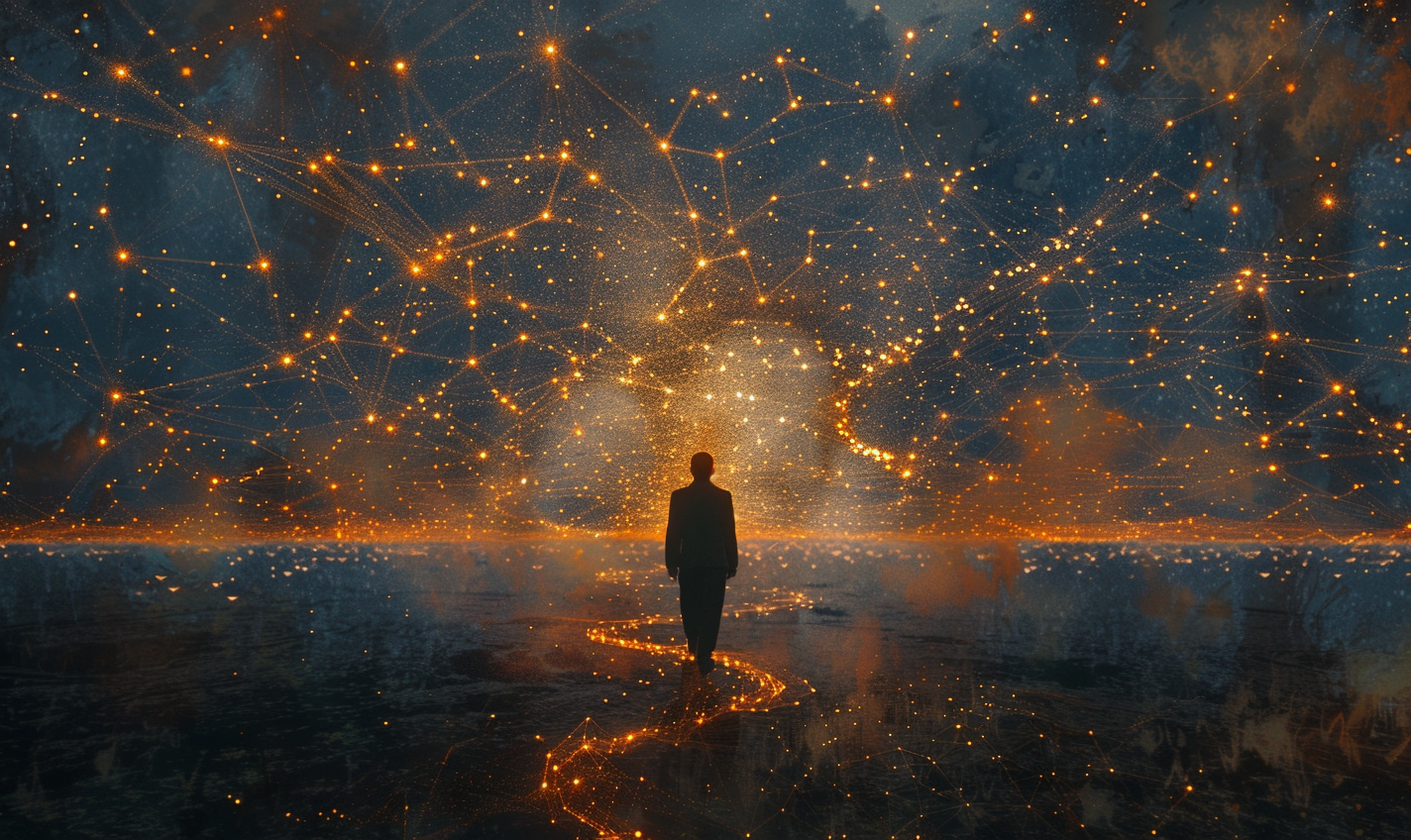
Manvir Singh’s answer, in his recent Behavioral and Brain Sciences target article, is subjective functionalism: cultural forms persist and spread because they feel good, with positive epistemic emotions acting as a universal compass for navigating what he calls the cultural manifold. In our commentary, Felix Schoeller and I argue that a decade of chills research supplies the empirical substrate for exactly that claim.
Aesthetic chills — the involuntary shiver that arrives during art, ritual, or a scientific insight landing all at once — are unusually well-behaved as objects of study. They’re discrete. They’re measurable. They happen when perception and cognition resonate along the cortical hierarchy. And they’re wired into dopaminergic reward circuitry: the ventral tegmental area, nucleus accumbens, and orbitofrontal cortex, with synchronized theta and beta oscillations across prefrontal and limbic networks.
But the dopamine isn’t signaling pleasure. It’s signaling validation — confirmation that a high-level layer of your world model just got corroborated by something outside you. As we put it in the paper:
The dopaminergic system whispers: “This fragment of the cultural manifold illuminates your position within it; integrate accordingly.”
Chills as a Grok Event
The cleanest analogy comes from machine learning. Grokking is what happens when an overfitted model, after a long stretch of no visible progress, abruptly generalizes — the leap from memorization to comprehension.
Chills are the physiological signature of that leap. The moment prediction error collapses and learning saturates. Subjectively, they arrive alongside insight, unity, meaning, and self-transcendence, and interoceptive awareness mediates the whole relationship: people more attuned to their bodily signals report stronger insight and more positive affect when the shiver hits.
Which reframes what’s happening when a piece of art wrecks you. It isn’t that the art is objectively good. It’s that the art fits — that it slots into your particular architecture and confirms a direction you were already traveling. Chills are how the body tells you the fit occurred, often before you can articulate what fit.
This is why no stimulus induces chills universally. Susceptibility varies systematically by demographics, personality, and state — a finding we’ve mapped across nearly 3,000 participants in ChillsDB. Those resonance profiles carve out micro-cultures of aesthetic preference, and we suspect they’re the empirical substrate of Singh’s cultural attractors.
From Selection to Surgery
Here’s where the title earns itself. Once you can reliably evoke chills, you have leverage over the machinery of epistemic validation itself.
We’ve begun using that leverage clinically — treating depression as a kind of disorientation within the cultural manifold. Exposure to ChillsDB stimuli decreased shame and increased self-acceptance in patients with major depressive disorder, mimicking phenomenological features of psychedelic therapy. Related work showed improved reward learning in anhedonic depression. And we’ve developed schema surgery: a generative-AI framework that produces personalized variants of chills-eliciting stimuli engineered to deactivate specific maladaptive schemas.
The ethical edge here is sharp, and we say so in the paper. Terrorist recruitment videos that emphasize shared humanity through martyrdom work on exactly this mechanism. Cultural technologies that harness chills can align or distort belief with equal power. Our preferred formulation:
Chills are both probes and promoters of meaning (as workouts are for fitness): they reveal and repair the coupling between world and self.
Art from Ornament into Instrument
The larger claim is that aesthetic emotions are not decorative by-products. They’re core cognitive calibration mechanisms — and they can now be measured, modeled, and modulated. That transforms art from ornament into instrument.
Follow the trajectory far enough and it gets genuinely strange. With neurotechnologies that let people self-induce the feelings art once evoked, culture may outgrow its artifacts. Konrad Lorenz suggested humanity might one day direct its own evolution; we’d argue that’s now plausible cognitively rather than biologically, by mastering the aesthetic mechanisms that once guided us blindly.
One More Thing
Felix and I got to talk through much of this on Radiolab, in an episode called The Holy Shiver. Their framing of the question is better than any of mine: what your body knows that your brain doesn’t … yet.
I’ll admit this one is personal. Radiolab has been running in my ears for essentially the entire span of my scientific life — the show that made the texture of curiosity feel like something worth chasing professionally. Getting to sit on the other side of it, talking about the exact shiver that got me into this, is about as full-circle as a career gets.