Get The Article
Cite This Work
- Article PDF

- APA
- MLA
- Bibtex
Cone, A., Zuzick, S., Durinski, T., Yates, E., Simonian, N., & Reggente, N. (2026). Alpha and theta audiovisual interventions in a reflective chamber demonstrate acute effects on stress and burnout. npj Digital Medicine.
Cone, Aidan, et al. “Alpha and theta audiovisual interventions in a reflective chamber demonstrate acute effects on stress and burnout.” npj Digital Medicine (2026).
@article{cone2026alpha,
title={Alpha and theta audiovisual interventions in a reflective chamber demonstrate acute effects on stress and burnout},
author={Cone, Aidan and Zuzick, Sam and Durinski, Tiffany and Yates, Eric and Simonian, Ninette and Reggente, Nicco},
journal={npj Digital Medicine},
volume={9},
number={1},
pages={55},
year={2026},
publisher={Nature Publishing Group UK London},
doi={10.1038/s41746-026-02555-z},
url={https://doi.org}
}
Simply put, we are living through a stress pandemic. Not in just the hyperbolic sense people throw around on social media, but in a measurable, documented, public-health crisis sense. Americans experiencing daily stress rose from 33% to 49% over the last two decades, and 85% of countries around the world reported rising emotional distress between 2008 and 2020. The consequences may have lasting impacts on public health. Chronic stress rewires the brain, tanks your immune system, and quietly erodes the cognitive sharpness you need to not only do your job well, but also to lead a happy life.
The usual advice of lifestyle changes such as healthy diet, daily exercise, meditation, therapy, or sometimes even medication, can be difficult for many people. Therapy takes time and money. Medication carries side effects. And meditation often requires a certain mental bandwidth that stress and burnout has already depleted (coming from someone who has experienced both). For people in high-tempo jobs—military, first responders, air traffic controllers, nurses—some of these solutions are simply out of reach.
So what if there was something faster, simpler, and passive? One of the latest papers from IACS, published in npj Digital Medicine, explores this new innovative treatment that feels more like science fiction than science fact.
The MindGym: A Mirror Box, Some Flashing Lights, and Binaural Beats
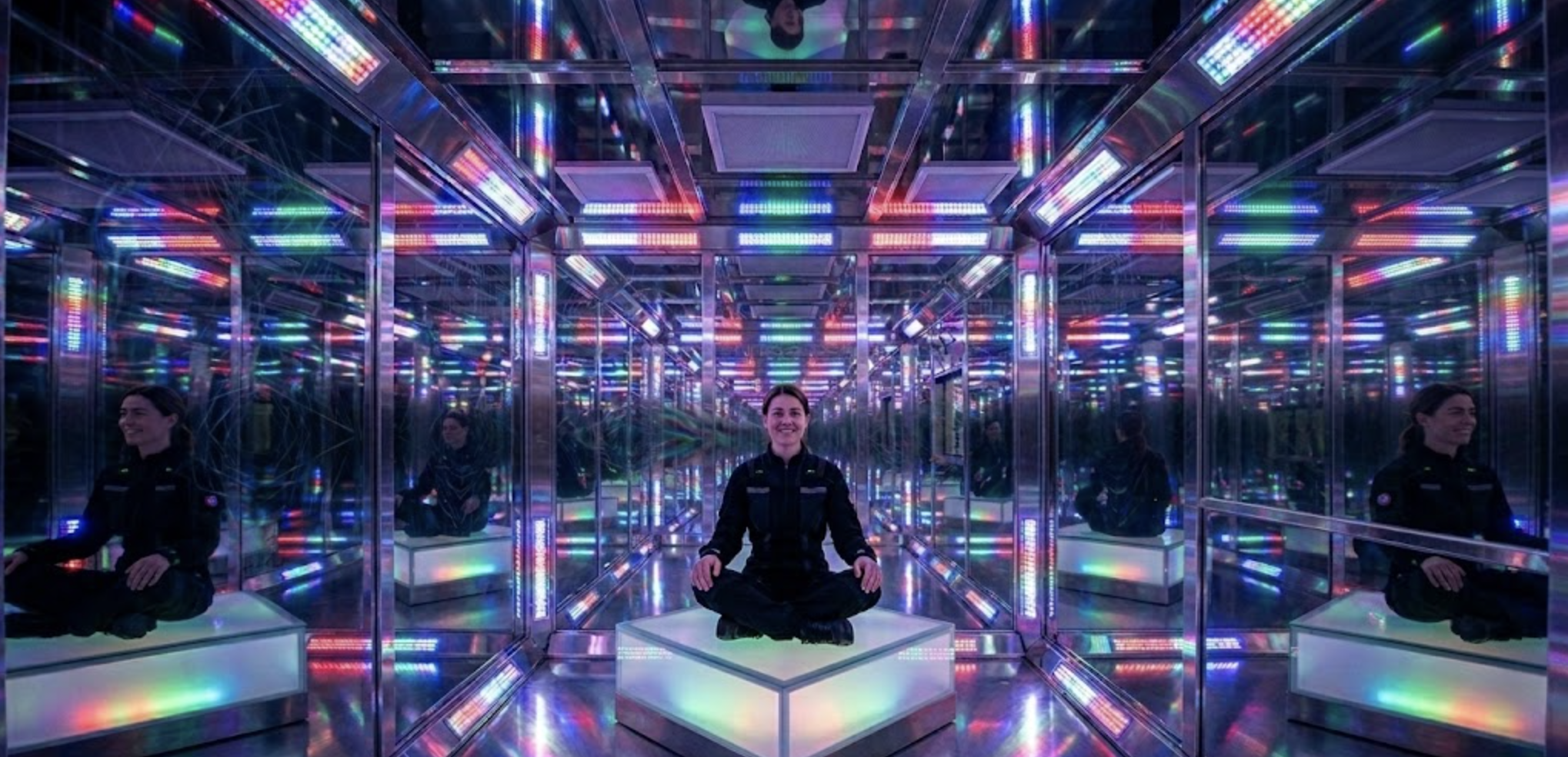
The technology we studied is called the MindGym—a 7-foot mirrored cube lined with programmable LED strips that flash synchronized light while participants listen to binaural audio through noise-canceling headphones. Figure 1 below shows a picture of what a MindGym looks like.
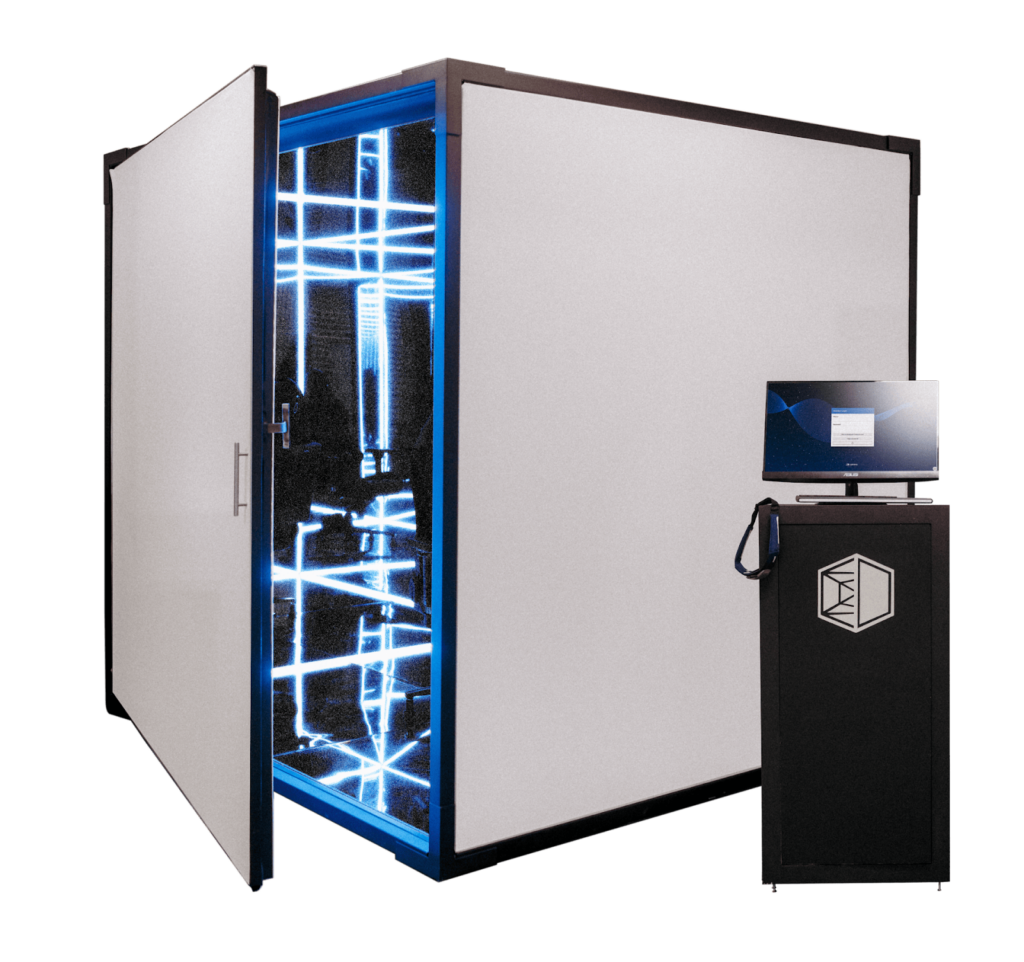
Figure 1. Lumena MindGym.
The experience lasts 23 minutes total, with 11.5 minutes of actual stimulation. Participants sit inside, follow simple instructions to open and close their eyes at different cues, and let the lights pulse around them. No meditation technique to learn. No therapist. No pills. A video demonstrating the theta protocol can be found here.
Seventy-four employed adults with self-reported high stress volunteered for the study. Everyone scored at least 14 on the Perceived Stress Scale, which is used as a threshold indicating moderate-to-high stress. They were randomly assigned to one of two protocols: one that flickered at alpha frequencies (9–11 Hz, associated with calm, relaxed alertness) and one at theta frequencies (4–7 Hz, associated with deep relaxation and meditative states). Both groups went through the same experience in the same chamber—the only difference was the speed of the flickering.
Before and after, participants filled out validated psychological questionnaires measuring anxiety, mood, vitality, flow states, perceived stress, and sense of purpose in life.
Building the Bridge: From Reflective Chambers to Stroboscopic Stimulation
IACS has spent the last several years investigating how immersive environments and rhythmic sensory stimulation can reshape stress and mood. In 2025, we published evidence that the MindGym, a mirrored cube lined with programmable LEDs, creates anxiety-reducing experiences comparable to meditation, and that these benefits translate seamlessly to virtual reality without loss of efficacy (read the study here). Just the year before, separate research demonstrated that brief audiovisual stimulation using stroboscopic light pulses can produce mood improvements rivaling weeks of meditation practice (read the study here).
The question followed: what if we combined them? What if we took the immersive quality of the reflective chamber and paired it with frequency-specific stroboscopic stimulation—light pulsing at either alpha (9–11 Hz, associated with calm alertness) or theta (4–7 Hz, linked to meditative states)?
This study represents a convergence: we asked whether the brain could be gently guided into beneficial states through synchronized light and sound, tailored to different neurophysiological frequencies. For populations too stressed to meditate, too time-constrained for therapy, and too skeptical of pills, we needed to know: could 23 minutes of engineered sensory experience move the needle on the stress pandemic we are going through?
What the Data Showed
Participants came out of the experience saying they felt miles better. The data supports this.
Anxiety scores dropped substantially from before to after the session. The gold-standard anxiety measure (STAI-State) showed one of the largest before-and-after changes we’ve seen in the lab and across the literature. We looked at the reductions in our study compared to 8-week mindfulness studies and found the MindGym performed exceptionally well and exceeded our expectations.
Mood appeared to improve across every dimension measured: depression, tension, anger, fatigue, and confusion all decreased. Negative emotions fell. Positive emotions rose. The overall “total mood disturbance” score—which captures the cumulative weight of negative mood states—dropped considerably from before to after the session.
Participants also reported increases in flow (that absorbed, effortless feeling of being fully present in the moment). Flow is difficult to induce experimentally, making this a particularly interesting observation to follow up on. Subjective vitality (a measure of felt energy and aliveness) also increased.
Even broader measures showed before-and-after shifts. Perceived stress, which was measured using a scale participants had filled out weeks earlier during screening, fell substantially. And sense of purpose in life increased.
All of these effects held up after statistical corrections for running multiple comparisons. But we would like to be clear: without an appropriate control condition, we can’t know how much of this reflects the intervention specifically versus expectancy, novelty, the simple act of resting, or the statistical tendency for extreme scores to move toward average over time. These are unresolved questions we aim to inform for future studies.
Did It Matter Which Protocol The Participants Got?
Interestingly, both protocols showed similar effects—there was no statistically significant difference between the alpha and theta group for most outcomes.
This raises more questions than it answers. If both frequencies produce roughly equal observed changes, what might actually be doing the work? The awe-inducing quality of the mirrored environment? The enforced stillness? Neural entrainment? Or some combination? This study design can’t tell us.
A prior study from IACS found the MindGym environment alone, without any stroboscopic protocol, was associated with modest anxiety reductions. The larger changes here suggest the protocol may be contributing something, but we can’t draw any conclusions yet.
There were many numerical differences between the two protocols that are worth investigating for future research: theta participants showed somewhat greater improvements in mood subscales and a larger before-and-after shift in sense of purpose in life, while alpha participants showed somewhat greater stress reduction. Neither of these differences are statistically significant, so they should be treated as hypothesis-generating observations.
Who Might Benefit Most?
The question everyone has been waiting for: how can we personalize this treatment, and who will benefit the most?
For people entering the chamber with higher baseline mood disturbance—more depression, anger, and confusion—the theta protocol was associated with larger pre-to-post changes in sense of purpose in life compared to alpha. For those who came in relatively less distressed, both protocols seemed to produce similar changes.
This hints at the possibility that future protocols might be eventually tailored to individuals based on their presenting state rather than random assignment. That’s something that still needs to be prototyped, but it’s the kind of question this pilot study was designed to motivate.
Why Should We Care?
The populations who most need fast, accessible, stigma-free relief are often the ones least able to access it. Military personnel, nurses on double shifts, first responders running on fumes—these are exactly the groups for whom a meditation class or weekly therapy session is hardest to sustain. Not because those approaches don’t work, but because of occupational time constraints and culture. There is a huge stigma of therapy in the military, not to mention sometimes it can take a servicemember off deployable status. Above all, cognitive exhaustion is real; the last thing someone may want to do after a week of sleep deprivation and getting rained on is sit for an hour and talk about it (speaking from experience).
An intervention that requires no training, no willpower, and no technique is worth investigating. The study was partially funded by a U.S. Air Force grant. If the Air Force is interested in it, you should be too.
What We Still Don’t Know
The absence of a control group is the central constraint. Without a comparison condition it’s not possible to attribute the before-and-after changes to the intervention itself. They could reflect placebo effects, natural mood changes across the session, the novelty of the environment, or simple rest. The observed changes are large, but large uncontrolled effects can still have non-specific explanations.
The improvements in sense of purpose and perceived stress carry a particular interpretive caution. These scales are designed to measure relatively stable tendencies, but administering them immediately after an unusual 23-minute experience may partly capture a temporary mood lift rather than a genuine shift in how someone relates to their life and stress over time. Follow-up measurements days or weeks later would be needed to know whether anything persists.
The neurophysiology is also unresolved. The EEG equipment used was consumer-grade and doesn’t cover the back of the head, the region where you’d most expect to see the brain syncing to visual flicker. So while neural entrainment is the theoretical mechanism behind the intervention, this study couldn’t confirm or rule it out. The “why it might work” question remains genuinely open.
The Bottom Line
This is an exploratory pilot study designed to ask whether a signal worth following up on exists, not to prove that a treatment works. By that standard, it found something worth pursuing. Before-and-after changes across anxiety, mood, flow, vitality, perceived stress, and purpose in life were observed in stressed adults following a single session. The changes were consistent across two different stimulation protocols, tolerability was excellent, and the statistical effects survived corrections for multiple comparisons.
What the study can’t tell us is whether those changes were caused by the intervention, how long they might last, or whether they would survive a properly controlled trial. Those are the questions that need answering next.
For a field trying to close the gap between “this works in theory” and “this works for people who are already too burned out to practice it,” a preliminary signal like this is worth paying careful attention to.
3 Responses
The idea of using alpha and theta audiovisual stimulation in a controlled reflective chamber is fascinating, especially given how widespread chronic stress has become. I’d be curious to know how lasting these effects are beyond the immediate session, and whether repeated exposure leads to more sustained changes in baseline stress levels. It feels like a promising direction, but long-term data would really help put the impact into perspective.
The statistic about stress rising to 49% among Americans highlights just how critical non-invasive interventions like these reflective chambers are for public health. It’s encouraging to see research validating such specific audiovisual protocols for acute relief, especially given the scale of the global emotional distress crisis. This approach seems to offer a tangible, accessible tool for managing burnout before it becomes chronic.
Amazing blog!